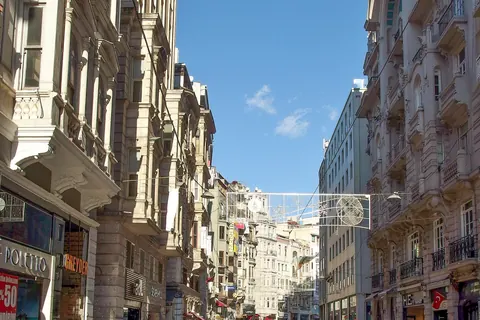
İstiklal Avenue is a 1.4 kilometre pedestrian street in the historic Beyoğlu district in Istanbul, Turkey. It is one of the most famous avenues in the city. It acquired its modern name after the declaration of the Republic on 29 October 1923, İstiklal commemorating Turkey’s triumph in its War of Independence.
The street starts at the northern end of Galata at Tünel Square and runs as far as Taksim Square. It was historically known as the Grand Avenue of Pera. İstiklal Avenue is flanked by late Ottoman era buildings in a variety of styles including Neo-Classical, Neo-Gothic, Renaissance Revival, Beaux-Arts, Art Nouveau and First Turkish National Architecture. There are also a few Art Deco style buildings from the early years of the Turkish Republic, and a number of more recent examples of modern architecture. Many would once have been apartment blocks but most are now occupied by boutiques, music stores, art galleries, cinemas, theatres, libraries, cafés, pubs, nightclubs with live music, hotels, historical patisseries, chocolateries, restaurants and a steadily growing number of international chain stores, as well as a branch of Madame Tussauds.
Galatasaray Square marks the middle of the avenue and is home to the oldest secondary school in Turkey: the Galatasaray High School, originally known as the Galata Sarayı Enderun-u Hümayunu. A monument, erected in 1973, commemorates the 50th anniversary of the founding of the Turkish Republic.
The avenue forms a spine with narrow side streets running off it like a ribcage. Many historical and politically significant buildings can be found on or immediately adjacent to Istiklal Avenue. They include the Çiçek Pasajı which is full of lively restaurants and taverns; the Balık Pazarı with the Armenian Üç Horan church to one side; the Hüseyin Ağa Mosque; the Roman Catholic churches of Santa Maria Draperis and S. Antonio di Padova; the Greek Orthodox church of Hagia Triada; several academic institutions established by Austria, France, Germany and Italy in the 19th century; and the consulates of France, Greece, the Netherlands, Russia, Spain and Sweden.
At the southern end of the avenue, it is possible to board the Tünel, which was inaugurated on January 17, 1875, making it the second-oldest underground urban railway in the world after the London Underground which opened on January 10, 1863. Nostalgic trams run along İstiklal Avenue, between Taksim Square and Tünel Square.
Sources
Text: introduction of the Wikipedia article İstiklal Avenue, under the CC BY-SA 4.0 licence (authors: article history). Facts: Wikidata (CC0). Coordinates: Wikidata, map background © OpenStreetMap contributors.